
Lower Back Stretches for Men: Reduce Pain and Move Better

Four out of five men experience back pain at some point in their lives, with the worst episodes typically occurring between the ages of 30 and 50. Yet despite how common it is, many men either push through it or avoid movement altogether, both of which can make things worse.
Lower back pain can result from muscle weakness and joint stiffness, poor posture, muscle strain from sudden movements, or underlying conditions such as a herniated disc or spinal stenosis.
Why Lower Back Pain Is So Common in Men?
Men tend to carry significant tightness in their hips and hamstrings, which creates a downward pull on the pelvis and increases lower back tension. Sitting too much weakens back muscles and tightens hamstrings further, compounding the problem over time.
The good news is that a consistent daily stretching routine can make a meaningful difference. Stretching enhances blood flow to sore muscles in the back, helps loosen tight muscles, and supports spinal health by improving circulation. You do not need equipment or a gym membership. You just need floor space and a few minutes each day.
Stretching can reduce lower back pain by up to 58%. Consistent daily stretching alleviates stiffness and increases mobility, making it one of the most accessible and effective tools for long-term lower back relief.
How to Loosen Tight Lower Back Muscles
The key to loosening tight lower back muscles is to address the whole chain of muscles that affect the lumbar spine, not just the back itself. Effective lower back stretches target the core, glutes, and hips together. The piriformis muscle, deep in the buttocks, is particularly prone to tightness in men and can contribute to lower back and sciatic nerve pain when left unaddressed. Tight hip flexors also create strain on the lower spine by pulling the pelvis out of alignment.
A physical therapist will often recommend starting gently and gradually increasing intensity over time. Stretching should only feel like mild tension, never sharp pain. When you stop moving, muscles tighten and that can make the pain worse. Movement, done correctly, is the medicine.
These lower back stretches for men can be done once or twice daily. Morning stretches help prepare the spine for the day ahead, while an evening routine helps release tension that has accumulated over hours of sitting or physical activity.
7 Lower Back Stretches for Men
1. Child's Pose
Targets: Spine, Glutes, Lats
Child's Pose is one of the most effective stretches for easing lower back tension. It gently decompresses the lumbar spine, releases the gluteus maximus and latissimus dorsi, and promotes deep relaxation throughout the back muscles. It is the ideal starting and ending point for any stretching routine.
1. Begin on your hands and knees, with your knees hip-width apart and toes together.
2. Sink back through your hips to rest them on your heels.
3. Hinge forward at your hips, walking your hands out in front of you with your palms flat on the floor.
4. Rest your belly on your thighs and let your forehead drop toward the floor.
5. Breathe deeply, relaxing any areas of tension with each exhale.
6. Hold for up to 1 minute. Repeat between other stretches as needed.
Modification: If your hips do not reach your heels, place a rolled towel under your thighs. Widen your knees and rest your forehead on a cushion if that is more comfortable.
2. Knee-to-Chest Stretch
Targets: Lower Lumbar, Hips, Glutes
The knee-to-chest stretch is a classic for good reason. It targets lower lumbar relief directly, relaxes the hips and glutes, and improves flexibility in the lower spine. This is a great stretch to do first thing in the morning before getting out of bed.
7. Lie on your back with both knees bent and your feet flat on the floor.
8. Keep your left leg with the knee bent, or extend it straight along the floor.
9. Gently pull your right knee toward your chest, clasping both hands behind your right thigh or at the top of your shinbone.
10. Lengthen your spine all the way down to your tailbone. Keep your shoulders flat against the floor.
11. Breathe deeply and hold for 30 seconds to 1 minute.
12. Return to the starting position and repeat with the other leg.
Tip: To deepen the stretch, tuck your chin into your chest and slowly lift your head toward your right knee. Repeat three times on each side.
3. Cat-Cow Stretch
Targets: Spinal Flexibility, Circulation
The cat cow stretch is a dynamic movement that gently mobilises the entire length of the spine. It enhances spinal flexibility and reduces stiffness, improves blood flow to the spinal discs, and wakes up the back muscles and abdominal muscles together. It is one of the best exercises for lower back mobility at any age.
13. Come onto all fours in a tabletop position, with your hands directly below your shoulders and your knees below your hips.
14. Inhale and let your belly drop toward the floor, lifting your head and tailbone upward (Cow position).
15. Exhale, tucking your chin into your chest and slowly round your spine toward the ceiling, drawing your belly button up toward your spine (Cat position).
16. Move fluidly between the two positions, following your breath.
17. Continue for 1 to 2 minutes, or hold each position for 5 to 20 seconds for a deeper stretch.
Modification: If you have wrist concerns, place your hands slightly forward instead of directly under your shoulders. Place a cushion under your knees if needed.
4. Piriformis Stretch
Targets: Piriformis Muscle, Sciatic Nerve Relief
Men are prone to tightness in the piriformis muscle, a small but powerful muscle deep in the buttocks. When the piriformis muscle tightens, it can compress the sciatic nerve, sending pain down the leg as well as into the lower back.
18. Lie on your back with both knees bent and your feet flat on the floor.
19. Cross your right ankle over the base of your left thigh, just above the knee.
20. Place your hands behind your left thigh and gently pull your left leg toward your chest until you feel a stretch deep in your right buttock.
21. Keep your shoulders flat against the floor and breathe deeply.
22. Hold for 30 seconds to 1 minute, then repeat on the opposite side.
Easier option: Keep your bottom foot planted flat on the floor instead of lifting your leg. Rest your head on a cushion for extra support.
5. Seated Spinal Twist
Targets: Spine Rotation, Hips, Abdominals
The seated spinal twist increases spine mobility and works the hips, glutes, abdominal muscles, shoulders, and neck all at once. Movements like this one can relieve pressure along the lumbar spine and are especially useful for men who sit for long periods at a desk.
23. Sit on the floor with both legs straight out in front of you.
24. Bend your left knee and place your left foot outside your right thigh.
25. Place your right arm on the outside of your left thigh and your left hand behind you for support.
26. Starting at the base of your spine, slowly rotate to your left side, keeping your spine tall.
27. Hold for up to 1 minute, then repeat on the other side.
Extra stretch: Add neck rotations while in the twist: inhale to look forward, exhale to look backward. Do 5 to 10 on each side.
6. Pelvic Tilt
Targets: Core Strengthening, Glutes, Hamstrings
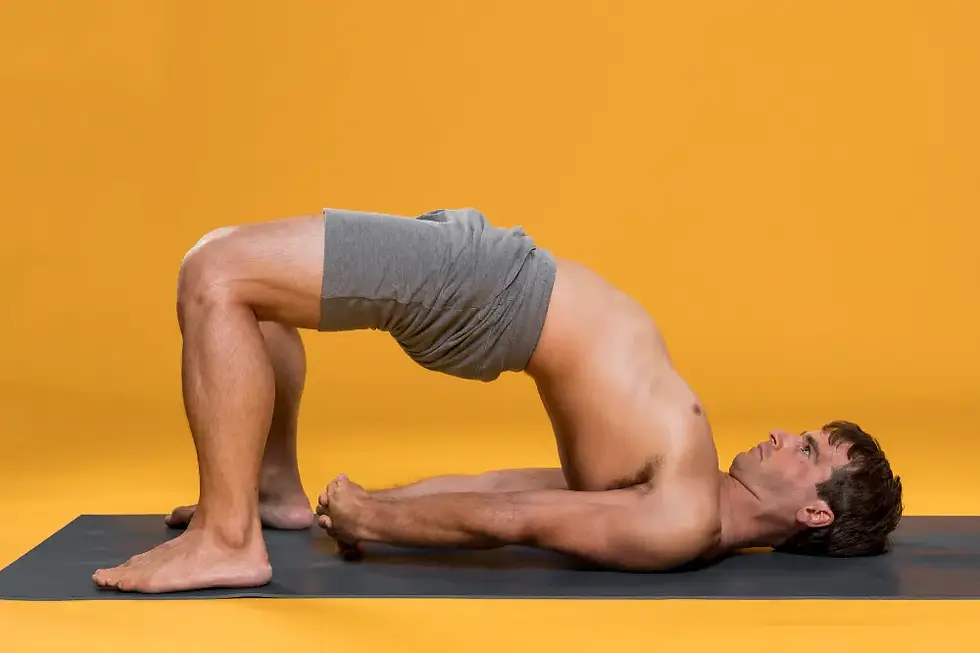
Unlike purely passive stretches, the pelvic tilt is one of the core strengthening exercises that also functions as a stretch. It builds strength in the abdominal muscles, which stabilise the lumbar spine and relieve pain. Passive stretching should combine with stabilisation like this to prevent back injuries from recurring.
28. Lie on your back with both knees bent, your feet flat on the floor, and your arms by your sides.
29. Gently engage your abdominal muscles, pressing your lower back flat against the floor.
30. Hold this position for up to 10 seconds, breathing normally throughout.
31. Release and take a few deep breaths to relax.
32. Do 1 to 3 sets of 3 to 5 repetitions, gradually increasing over time.
Progress tip: Once this feels easy, gradually increase to 10 repetitions per set. Combine with a hamstring stretch for best results.
7. Sphinx Stretch
Targets: Spine Extension, Buttocks, Chest
The sphinx stretch is a gentle backbend that both stretches and strengthens the spine, buttocks, and chest. It is particularly recommended for men with disc-related lower back pain, as it encourages the spine to extend into a neutral position. A physical therapist may prescribe this as part of a herniated disc recovery program.
33. Lie on your stomach with your legs straight and your elbows directly below your shoulders, palms flat on the floor.
34. Set your feet slightly apart.
35. Gently engage your lower back, buttocks, and thighs as you slowly lift your head and chest off the floor.
36. Keep your pelvis pressed firmly into the floor and your abdominal muscles lightly engaged.
37. Gaze straight ahead or gently close your eyes and breathe deeply.
38. Hold for 30 seconds to 1 minute.
Note: Avoid this stretch if you have spinal stenosis, as spinal extension can aggravate that condition. Speak with a physical therapist if unsure.
How to Stretch Your Partner's Lower Back
If you are looking to help a partner with lower back pain, assisted stretching can be very effective when done gently and with clear communication throughout. The most important rule is to move slowly and check in frequently about comfort level.
For an assisted knee-to-chest stretch, have your partner lie on their back with knees bent and feet flat. Place one hand under their knee and one behind their thigh, then slowly guide one knee toward their chest until they feel a gentle stretch. Hold for 30 seconds and slowly return to the starting position before switching to the other leg.
For an assisted trunk rotation, have them lie on their back with legs bent at a 90-degree angle and arms straight out to the sides. Place your hands gently on their knees and slowly roll both knees to the left side. Hold for 15 seconds, return to centre, then slowly roll to the right side. Never force movement. If they feel sharp pain at any point, stop immediately.
Can Stretching Help with Delayed Onset Muscle Soreness?
Delayed onset muscle soreness (DOMS) typically peaks 24 to 72 hours after exercise, especially after a new or intense workout. Gentle stretching after exercise can help reduce the severity of muscle soreness by increasing blood flow to the affected muscles and helping them relax.
Stretching enhances blood flow to sore muscles in the back, which speeds the removal of metabolic waste products and delivers oxygen and nutrients to the tissue. While stretching alone will not eliminate DOMS, incorporating it into your post-exercise routine can meaningfully reduce how long muscle soreness lasts. Regular walking is also associated with a lower risk of ongoing back pain and helps keep the surrounding muscles mobile between stretching sessions.
5 Red Flags of Low Back Pain
Most lower back pain is mechanical and responds well to stretching and physical therapy. However, some symptoms signal more serious underlying conditions that require prompt medical attention. Stop stretching and contact a doctor if you experience any of the following:
• Pain that radiates down one or both legs below the knee, especially with numbness or tingling, which may indicate nerve compression or a herniated disc affecting the sciatic nerve.
• Loss of bladder or bowel control alongside lower back pain, which may indicate cauda equina syndrome, a medical emergency requiring immediate attention.
• Back pain following a fall, accident, or direct trauma to the spine, even if the pain initially seems mild.
• Unexplained weight loss combined with persistent back pain, which can occasionally signal an underlying systemic condition.
• Pain that is constant, severe, and does not improve with rest or position changes, or pain that is significantly worse at night.
If pain persists beyond a few weeks despite a consistent stretching routine, consulting a physical therapist is strongly recommended. A physical therapist can identify whether your pain stems from muscle strain, joint stiffness, spinal stenosis, or another condition, and design a personalized exercise program accordingly.

Tips for Building a Lasting Stretching Routine
The stretches above are most effective when done consistently. Here are practical strategies to make your daily stretching routine stick:
• Attach stretching to an existing habit, such as right after waking up or before bed.
• Start with just two or three stretches if seven feels like too much, and gradually increase.
• Breathe deeply throughout each stretch to help your nervous system release tension.
• Avoid sudden movements that jolt or strain the back, especially first thing in the morning.
• If you find a stretch that relieves your tension, keep doing it indefinitely.
• Combine stretching with core strengthening exercises for the best long-term results.
Frequently Asked Questions
How often should men do lower back stretches?
Most stretching routines can be done once or twice daily. If you experience muscle soreness after a new routine, take a rest day and resume gently. Consistency matters more than intensity.
Should I stretch if my lower back hurts?
Gentle stretching can help relieve tension in many cases of lower back pain. However, if stretching makes the pain worse or you experience sharp pain or nerve symptoms in your legs, stop and speak with a doctor or physical therapist to determine the cause.
What is the fastest way to loosen tight lower back muscles?
Child's Pose and the Cat-Cow stretch are among the fastest ways to loosen tight muscles in the lower back. Both mobilize the spine immediately and can be held or repeated for quick relief within a few minutes.
Can I do these stretches at the office?
The seated spinal twist and a simple lumbar extension standing stretch can be done at a desk or in a break room. A physical therapist often recommends doing a brief spinal extension every hour when sitting for long periods to relieve disc pressure.


Comments